07 February 2026

#7 - A Ragged Train

Fay Roberts’s second sonnet this year is inspired by Satyajit Ray’s groundbreaking novel adaptation: Bengali movie, Pather Panchali (1955), written by Bibhutibhushan Bandyopadhyay (author of the autobiographical novel) and Satyajit Ray, and starring Kanu Bannerjee, Karuna Bannerjee, Sarbojaya Ray, Chunibala Devi, Uma Das Gupta, and Subir Banerjee.

A mother’s worries never seem to end,
and father’s dreams are solipsistic, vast,
so what is she to do but scrape and mend,
and cling to hopes betrothed to class and caste?

A web of obligations resonates
in sickness and in health, and dimly lit.
As seasons come and go, she numbly waits,
her daughter not content to fret and sit.

She runs, and climbs, and perturbates, and cares,
and swears that she will never be a wife.
And what’s the punishment for she who dares
the crime of wanting better for her life?

You’ll find out, being hitched to faulty stars,
what disappointing creatures poets are.
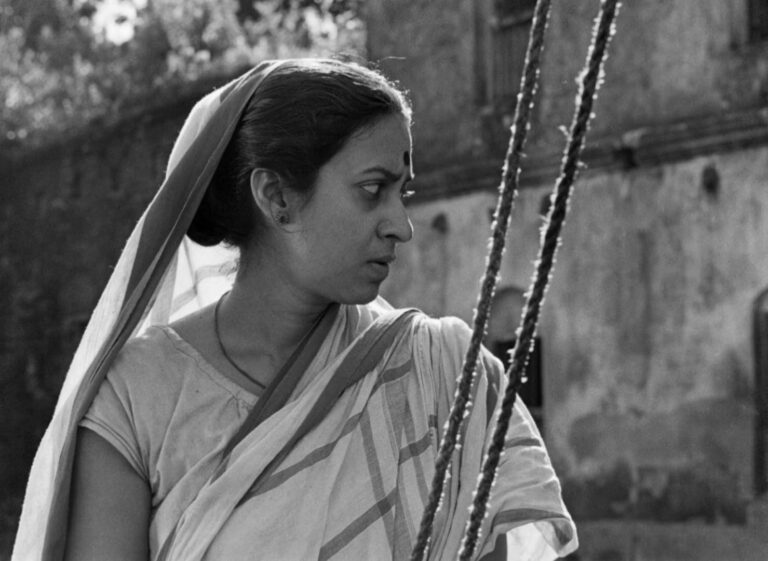
Black and white movie still of an Indian woman in her 30s with her head turned to one side, a fold of her white sari with checkered stripes covering the back of her sleekly pulled-back, black hair. In front of her two thin, taut ropes, behind a high wall with domes windows set in it. Her brow is furrowed, and she looks tired and pensive.
Image of Karuna Bannerjee as Sarbojaya Ray from the Cinematograph review

If you have access to Wikipedia, you can watch the 2:04 long, Bengali language movie here (or on Amazon Prime with very different subtitles and worse image quality). Content warnings include: poverty, death, casual family violence. Let us know what you thought if you’ve seen it!

06 February 2026

#6 - Late Spring (1949)

This poem was inspired by the film Late Spring (1949). It was by directed by Yasujirō Ozu, and was produced in Japan during the American occupation after the Second World War. I was especially interested in the aspects of the film that were censored (mentions of American bombing and occupation, and the Japanese traditions that do not align with American values specifically) and how the Ozu skirted these rules to make something that still resonates with Japanese culture at this time and place. You can read more about that on Wikipedia here, if you like.  


#6 – Tiny Acts of Rebellion  

I cannot write of city ruins here,
our script is flipped; the harrowing erased.
The absence curves, like question marks in space:
the gauzy veil of history hangs sheer. 

I cannot tell of occupation now:
it lies, like rubble, hidden from the lens.
And I’m reduced to shaking, making sense 
of censorship and all it won’t allow.

But, in the mise-en-scène, you’ll see it clear:
the English words, the Coca-Cola sign.
On celluloid, the darkened shadows shine,
the bleakness in the staging, rendered here. 

A portent, camouflaged for us to find;
rebellion as subtle as a sign.


LM


Image from Late spring (1949) from Wikipedia


05 February 2026

#5 - das Feuer, die Stimmen, die Qualen

M, 1931


Some poets say that writing’s a compulsion –

like somehow, they’re afflicted with a curse;

they speak in terms of horror and revulsion

at something so benign as crafting verse.

“I need to quench demonic fire inside –

to quell demented voices, vent the rage,

and tear my psyche open naked wide –

eviscerate my torment on the page!


Suffice to say I differ from this norm –

my muse is cut from calmer cloth, it seems.

A privilege is poesy, not a duty –

the fire’s a spark that keeps me toasty warm;

the voices, long-dead poets sharing dreams;

the torment, only heartache caused by beauty.

AWB

for a video reading of this poem and more, visit Andy's Patreon


04 February 2026

#4 - shot-for-shot

(Russell J Turner)

This year we are using films from the Sight and Sound 2022 list as prompts

First up from me is Alfred Hitchcock’s Psycho (1960 - #33), along with Gus Van Sant’s pointless remake


Our Californian butchery begins
not far from Fairvale, where the Bates Motel
stands like a monument to filial sins ‒
a seedy small-town cinematic hell.

Conversant with the carnage that ensued,
some cineastes will bore us with the cast ‒
“But did you know the characters include
the wonderfully named Milton Arbogast?”

Then Gus Van Sant, in nineteen ninety-eight,
decided to completely replicate
this classic film ‒ a shot-for-shot redraft
that’s more to do with marketing than craft.
Though given Norman’s chosen tool of strife,
perhaps not shot-for-shot but knife-for-knife...


RJT


03 February 2026

#3 - Enmeshed

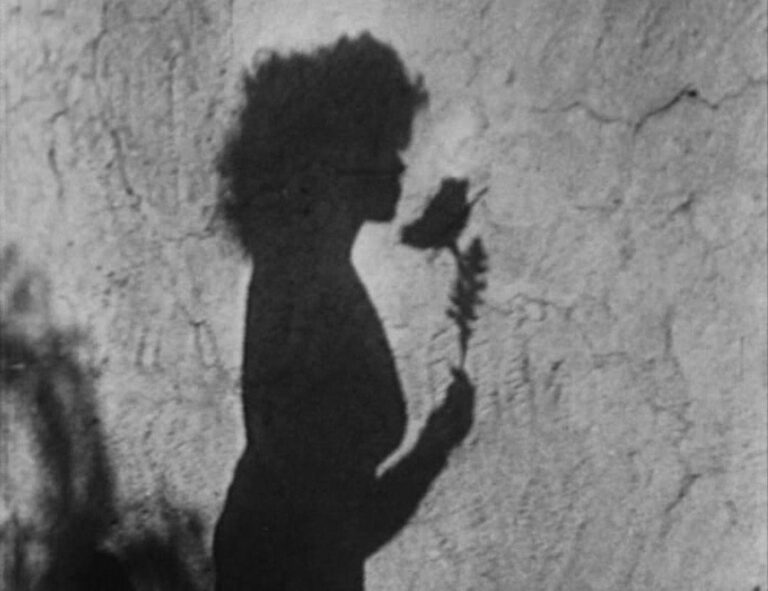
Fay Roberts’s first sonnet this year is inspired by Maya Deren and Alexander Hammid’s short, surrealist, USAmerican movie, Meshes of the Afternoon (1943), written by Maya Deren, and starring Maya Deren and Alexander Hammid:

She runs and runs, but never hopes to catch
the chiffon billowing, the mirrored stare.
She rises, clambers, thinks she’s met her match.
(But who’s to say, in this dim place, what’s fair?)

It’s soft and hard, she’s bright and dark, alone?
The key’s inside, and gravity’s a glitch.
Acknowledge nodding roses, keys, and clones...
Is this prediction? Time to flip the switch.

Now tread each texture down, don’t run in place –
the sea’s a sighing echo of the land...
We rise to find the only speaking face;
this is no accident, but was it planned?

Was she possessed? What did the dream portend?
And who’s the one who’s dreaming, in the end?

a greyscale silhouette against a white wall of a person with abundant, tightly curled hair holding a large flower to their face
still of the movie, from of the review on THE CINEMATOGRAPH

If you have access to the Internet Archive, you can watch the 0:14 long, mostly wordless movie here. Content warnings include: implied violence, unreality, blood, nightmares. Let us know what you thought if you’ve seen it!

02 February 2026

#2 - Beau Travail (1999)

This poem was inspired by the 1999 French film Beau Travail, which was directed by Claire Denis. The film is set in the former French colony of Djibouti, and the main characters are all French Foreign Legion soldiers. I haven’t seen the movie (yet) but as I was reading the plot description online, I was struck by the themes of power, cruelty and disorientation in the story. These were the things that were swirling around in my mind when I wrote this poem.  It’s also my first time playing with an unrhymed lines in a sonnet – sacrilege! 


#2 - Good Work 

In this expansive openness, we men
are gods, and just like gods, we seek to cause 
destruction of our fellow deities;
a desert of our twisting spite and shame. 

This heat incites each man to lose his way – 
his empathy a glittering mirage.
This heat incites each god to dissipate –
and we are left as devils on the sand. 

The work is always harder than it seems,
and gods and men are harder, still, to bid.
The desert swallows all, no compromise;
it swallows, spits, and saves us from ourselves. 

We wanted to believe we did some good;
the wreckage, lying silent, seeping blood. 


LM


Poster Image via Wikipedia


01 February 2026

#1 - Watershed


The mountain rises ­– rain falls either side;

the river carves new courses thru the plain

the views will never be the same again

as fertile meadows form, which coincide


with fauna stirring, brash and dewy-eyed.

this metaphor’s attempting to explain

the moments I first met Charles Foster Kane –

murmuring veiled macguffins as he died.


That’s it? I wondered, What’s the fuss about?

a callow youth so sure of what he knows

too blind to spy invention’s fearless edge –

to see the context; then to puzzle out

the level land before the mountain rose

and Ozymandias in a burning sledge.


AWB


for a video reading of this poem and more, visit Andy's Patreon