Showing posts with label mythology. Show all posts

19 February 2024

#19 - Dodging the Obvious

Far from home, but inspired by our planetary twin so close at hand, Fay Roberts (with a little help from zir friends) addresses Venus, another of the Classical Planets:

Now heralded by conches, you emerge;
adrift no more, your light is always there.
And though you rise and fall, your fateful surge
impels your host to heights beyond compare.

Your blissful dissonance beguiles our rest;
your messages of hope inform our dreams;
though many only see you at your best,
still others fall to wanton, guileful schemes.

It seems you run more hot, support less life
than Gaia, standing in the line of fire,
and those who skip the research offer strife
in your name to us souls blown in the gyre.

Though maiden, mother, victor, bearded, bald,
in any guise you’re more demand than skald.

Against a black backdrop, a planet divided - on the left a serene-looking half in swirling shades of sandstone, dove grey and, at the top, baby blue. On the right a black half highlighted in jagged patches of vivid orange
Processed using infrared and ultraviolet (IR1, IR2, UV1 [283nm, 365nm]) filtered images of Venus taken by Akatsuki on August 24 and September 4 2016. JAXA/ISAS/DARTS/Kevin M. Gill via Wikimedia


15 February 2024

#15 - Eclipse Us

Lackadaisically lunar, Fay Roberts dashes in under the closing door of the day with a take on the Moon, as part of zir examination of the seven Classical Planets.

We’ve longed for you as long as we have gazed
above our darkened state to raise the stakes,
and every nation large or small has praised
that glass in which we magnify mistakes.

You fill our nights with wonder and we miss
your silver bars when you have ducked from view.
While lovers tumble, grapple, howl, and kiss,
your visage blushes red, and royal blue.

As tides cannot be conquered, and the light
that hides in stubborn syzygy can’t die,
so you, our nearest neighbour in the fight
against our murky nature must not fly.

Strange forces change the nature of our tryst,
but, as we drift, please know your view is missed.

– FR

A continuous, looping GIF of the Moon's Libration (i.e. phasing in and out of darkness). At the top is a scrolling set of dates from October 12, 2007 through the 28 days of the phases.
Lunar Libration with Phase October 2007 by Tomruen via Wikimedia


03 February 2024

#3 - King of the Six

 As Fay Roberts explores the Seven Classical Planets this month, ze starts far out with Saturn

We start in darkness – where else could we hide 
from father feasting at the edge of light? 
Bright issues spring from him, and more besides, 
his bloody harvest garlanded with spite. 

He tells us that his rule’s a Golden Age 
(before we learn to fear, and then to hate), 
and verdant meadows form an open cage 
without the fire with which we circle fate. 

But in the depths of winter tables turn, 
the lowest mounting up on stilts of mirth, 
and in the dark the merest glimmers burn – 
together we relearn to coax hope’s birth. 

While those about to die acknowledge him, 
it’s better to be sanguine than be grim. 

– FR

The astrological symbol for Saturn, ♄, is set on a very dark blue, circular background
Avoiding copyright issues, Fay made this graphic zirself.


15 February 2023

#15 - Puppies Undertake Apotheosis

Trawling ides, Fay Roberts finds inspiration in strange, old rituals and cycles of secretive, sanguine social structures.

Round and round the Palatine the bold young wolflings stride,
striking those who ask for it as in the days of old.
It’s hard not to be confident with gods ranged on your side.

They know full well – they’re often told – how they’re their mothers’ pride,
and all the gifts with which they’re blessed have caused them to be bold.
Round and round the Palatine the bold young wolflings stride.

Although it’s been vouchsafed to them the world is very wide,
they’d rather stay right here, at large, than risk the broader wold
(it’s hard not to be confident with odds ranged on your side).

Blood-bedecked, demanding laughs, they take their strips of hide,
and go in search of desperate girls who’re told their blows are gold.
Round and round the Palatine the bold young wolflings stride.

They’ve been persuaded to this place by older, bolder guides
who promise wisdom in exchange for something like a soul.
It’s hard not to be confident with gods right by your side.

They find their faith is strengthened, the more that they’re decried;
they’ll purge the world of opposition, never mind the scolds.
Round and round the Palatine the bold young wolflings stride;
it’s hard not to be confident with gods ranged on your side.

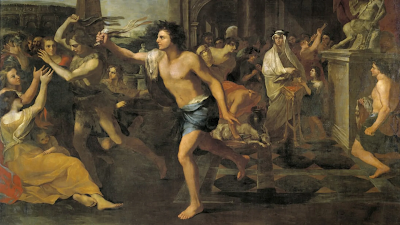
Dark oil painting of a crowd of generally slender, generally young, generally white folk in Rome. There are dark, patterned tiles underneath, but they appear to be in an open air building with columns and arches, and views of other Roman landmarks. There is a statue of the god Pan (or Faunus), goat-legged and pipe-bearing on a plinth in the background. Most of the focus is on two barely-clad young people in the foreground, draped in hides and streaming, many-stranded flails in their upraised right hands as they run towards women who raise their arms beseechingly. Most people seem to be ignoring the two young men, engaged in all sorts of activities, conversing, drinking, playing pipes, or locked in embrace. The general air is of a dark chaos and fun taken all too seriously...
Lupercalia, by Andrea Camassei (c.1635), found via the Mental Floss article about the festival
(image description in alt-text)


11 February 2023

#11 - 134340

Wishing for some kind, cold, trans-Neptunian darkness in zir migrained state, Fay Roberts circles in late with a tribute to a contested celestial wanderer who headed further out on this day in 1999.

This mournful song, this frozen king;
in mysteries of glowing ice
heavenly bodies cross and swing.

Join hands and chant around the ring,
and hearken how he paid a price;
this mournful song, this frozen king.

Tell him: no more curtseying,
democratise this frozen slice
where heavenly bodies cross and swing.

His numbers always dwindling,
though most refuse to sacrifice
their mournful song, their frozen king.

And chaos shuns quick measuring.
A simple tune? That’s far too nice
for heavenly bodies crossed to swing

So children, if you’re wondering…
pay homage still, that’s our advice
with mournful song, your frozen king
whose heavenly bodies cross and swing.

- FR

A rocky, barren, weathered and pockmarked landscape in shades of grey and dark brown stretches out, bnrightly lit, under a harsh and unseen source of light from the close, very dark sky overhead, in which is also visible a narrow sliver of a vast, nearby moon just over the slightly hazy horizon.
An artist’s impression of the surface of Pluto in response to data from the European Southern Observatory’s Very Big Telescope (seriously - that’s what it's called!); image description in alt-text.


27 February 2020

#26 – A Matter of Interpretation

Neu: Materion Dehongli

The Gog Magogs is part of what passes for a mountain in Cambridgeshire, complete with a myriad odd tales – the nomenclature is suitably confusing, considering that a) the legend to which it appears to pertain is i) based in Cornwall or Devon (to do with the legendary invasion of the Trojans to found Britannia), and ii) probably a corruption of the Welsh for “Madoc The Giant”; and b) getting some precision over which bit is Gog, which Magog, and why they’re even called that is a thankless task that Wikipedia, for one, shuns. Then we tack on the whole Biblical thing about who even Gog and Magog are supposed to have been/ be, and three conspiracy tales later (this year’s theme has seen me visit a surprising number of them in my cryptid research and I can only imagine that the secret service agent assigned to my internet browsing history must be having a more interesting month than usual) sees me throw my hands up and pluck this mash-up from the depths of recent forays into online conversations in flexible tongues (with grateful thanks to the custodians of this particular rhyming dictionary, a ymddiheuriadau i unrhyw siaradwyr Cymraeg ma).


“The giants’ mothers came from overseas;
“Their father cast them forth for being bold.”
Their guide’s face twists, like talking of disease;
They shiver in the damp, persistent cold.

They root him out at last, curled up in sleep.
“Mound to men come forth!” they rattle, proud.
“It’s prophesied your death shall sain our keep!”
O dewch, come on, mae’n gynnar – not so loud!”

He sighs, his height unfurls, their heads reel back.
Hands tighten on their weapons, shoulders square.
Proffwydoliaeth? Nah, I’ll dodge that cac.
“You want this spot? Dim ots, I’ll move up there…”

Y Gwirionedd Hanes? Anodd iawn.
Mae’n amlwg weld nad yw ein wlad yn llawn.

– FR

Corineus or Jack? Pwy sy'n cymrawd bach hwn?

25 February 2020

#25 - The Pfeffel, The


The kishi is a two-faced demon in Angola. Alexander Boris de Pfeffel Johnson is the Prime Minister of the United Kingdom. 

If you can think the mighty throne you’re sat in,
was fairly fought for, just as justly won;
if you can fool the plebs by riffing Latin,
the public schoolboy’s old sine qua non;
if you can state that Bloodline, Breeding, School,
is what keeps Britain great – and think it true;
if you just know those hallowed, ancient rules
apply to other people, not to you;
if you believe that lies and propaganda
are statesmanlike, and Kiplingesque to boot;
then Johnson, (Boris?) (Pfeffel?) Alexander –
fuck off, and suck a bag of dicks en route;
and when you make a heap of all your winnings,
remember that there ain’t a second innings.
AWB
Attribution: https://www.instagram.com/p/BwPsiSzlmbs/ 
http://custombysophy.com/about/


15 February 2020

#15 - Do they make Nurofen for zombies?

A jiangshi, also known as a Chinese hopping vampire or hopping zombie, is a type of reanimated corpse in Chinese legends and folklore. Jiangshi can be created in a number of different ways, including through the use of supernatural arts to resurrect the dead. This poem is a cautionary tale: being a zombie isn't all it's cracked up to be...


Not every remedy is kindly meant,
and what is built to cure can wound instead.
I am the accidental revenant
since, after death, not all of us are dead.

The stiffness in my limbs is pain enough
without the throbbing chaos in my head.
My soul is dislocated, and it’s tough
to shop for analgesics when you are dead.

Who hasn’t wished that they could have more time?
That primal yearning passion to exist.
It’s tempting to outstay the final chimes
without a backward glance, but not like this.

No paracetamol will numb the ache
of being half asleep and half awake.

LM 

The characters for Jiang Shi mean 'stiff corpse'

14 February 2020

#14 – Met Josef, Ben Davar

The Prague golem is considered (by Wikipedia, at least) the classic version of the golem myth, which word is only mentioned in the Bible once. The tale is said to be apocryphal at best, and yet lives on in thousands of reproductions (including statues, comics, cartoons, horror films, novels  – Frankenstein, The Sorcerer’s Apprentice, The Terminator? – wrestlers, restaurants, and poetry). I tried a technique to reflect the nature of hidden words and layered meanings – let me know how you thought I got on…

And at the very start, you rose in truth,
Light form wet-raw, and rough as recompense;
Effective ward against those lacking ruth,
Pauldron on the arms of innocence.

Healing isn’t what he made you for –
Likely you’re a goad to push back hate,
Aping what you witness in the law,
Made to make your maker curse his fate.

Emptiness consumes the hours you toil,
Darkness casts you into strong relief,
Hubris dogs you both in ash-damped moil,
Tantamount to beggaring belief.

As he withdraws his love you fade and fall,
Vain witness to how cruel loss makes us all.

– FR

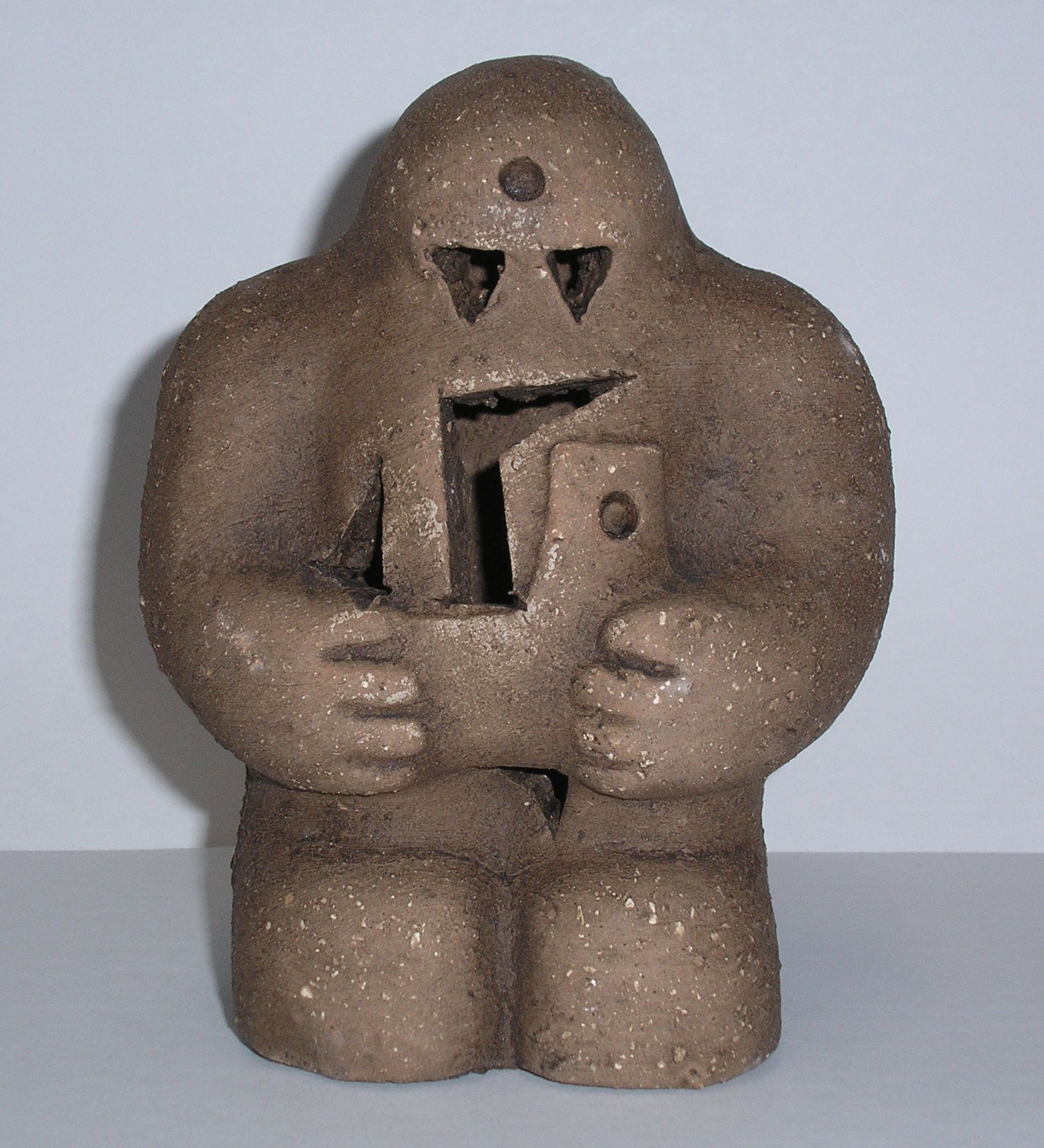
Even altering one letter of the golem’s shem can render it lifeless

02 February 2020

#2 – Sasquatch

Sasquatch: noun, anglicisation of the Halq̓eméylem (Stó:lõ dialect) term sásq'ets, meaning “wild man”. Source: Wikipedia and The Bigfoot Field Researchers Organization.

It’s said that there are those who claimed us hoax,
And those who only wanted to believe,
Despite the hopes, the fears, the jeers, the jokes;
It seems the sightings caused soft hearts to grieve.

Some praised our strangeness, labelled us benign;
Some called us elders come back from the dead.
But others warned we were not so divine –
We’d steal incautious children from their beds.

We shook the trees, took salmon from their nets;
We poisoned ground and toppled holy art.
We stripped the land, flipped treaties into threats,
And proved ourselves the wilder men at heart.

As well believe the Bigfoot to be real,
As trust a white man’s promise on a deal.

– FR

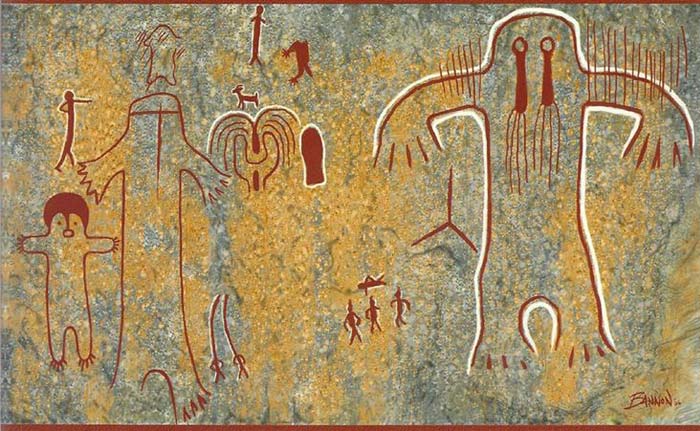
Purported Ancient First Nations art depicting Bigfoot, though I can’t find out where it’s from originally...


Predominantly reported in the Pacific North-West, the name Bigfoot is relatively recent (mid-20th Century). They have many names among First Nations People in the region, and their legend ranges from gentle, through to whistling child-snatchers who must not be named. In 1940, Indian Agent J. W. Burns, republishing his tales from the 1920s as collected from the people of the region, borrowed the term Sasquatch from the Halq̓eméylem sásq'ets (IPA: [ˈsæsqʼəts]) and used it in his articles to describe a hypothetical single type of creature portrayed in the local stories. There are a frankly astonishing number of websites dedicated to researching and preserving the notion of a real-life creature.